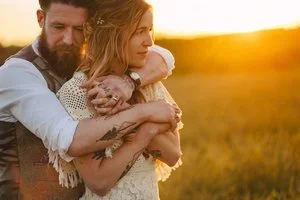
Winter Elopement in Northern Ireland: The Season Nobody Told You to Book
Most elopement guides treat winter as a liability. They’ll mention it at the end of a season breakdown… winter can work if you’re flexible, but be aware of short days and unpredictable weather… and then spend the rest of the page steering you toward May or September.
I want to make a different argument.
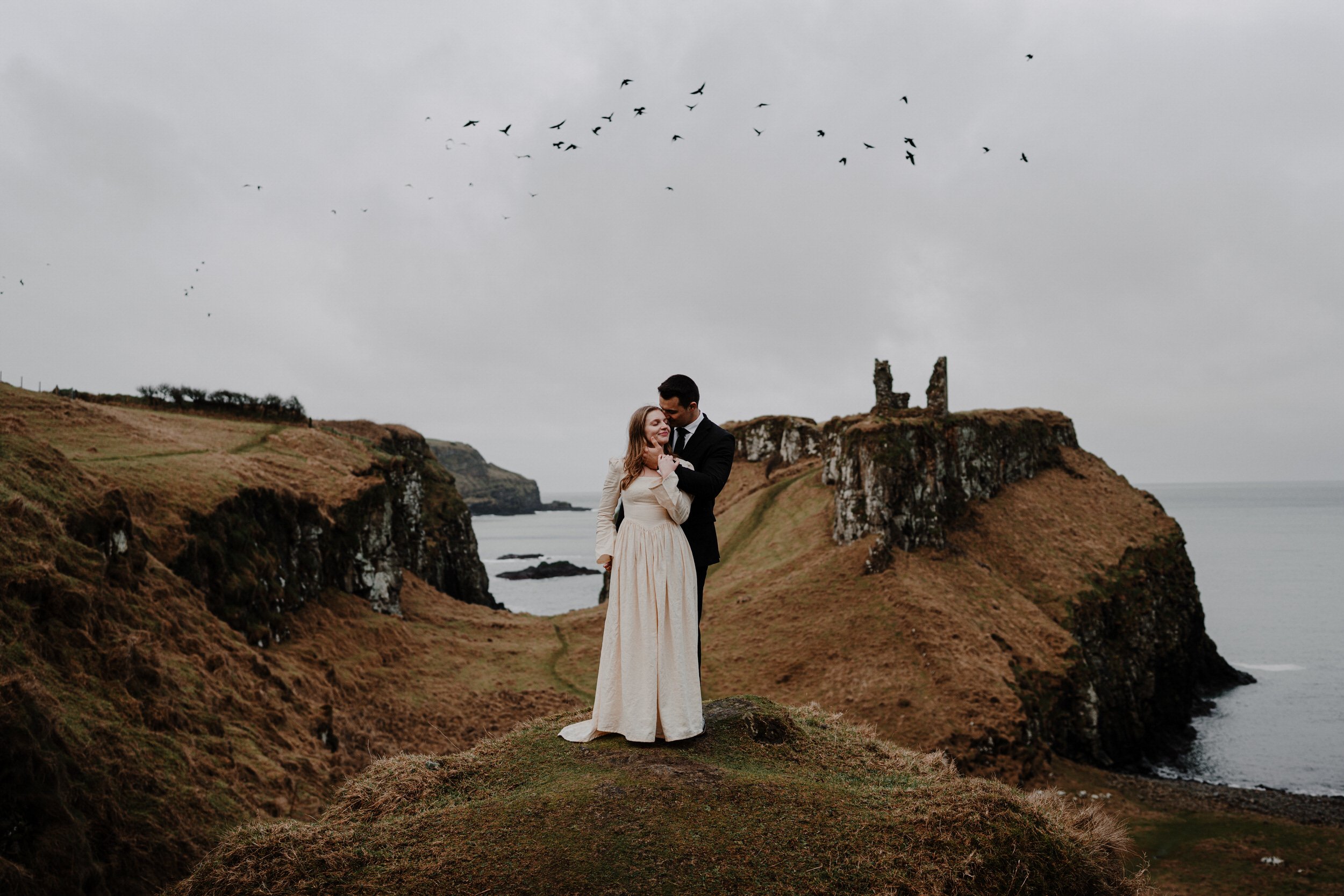
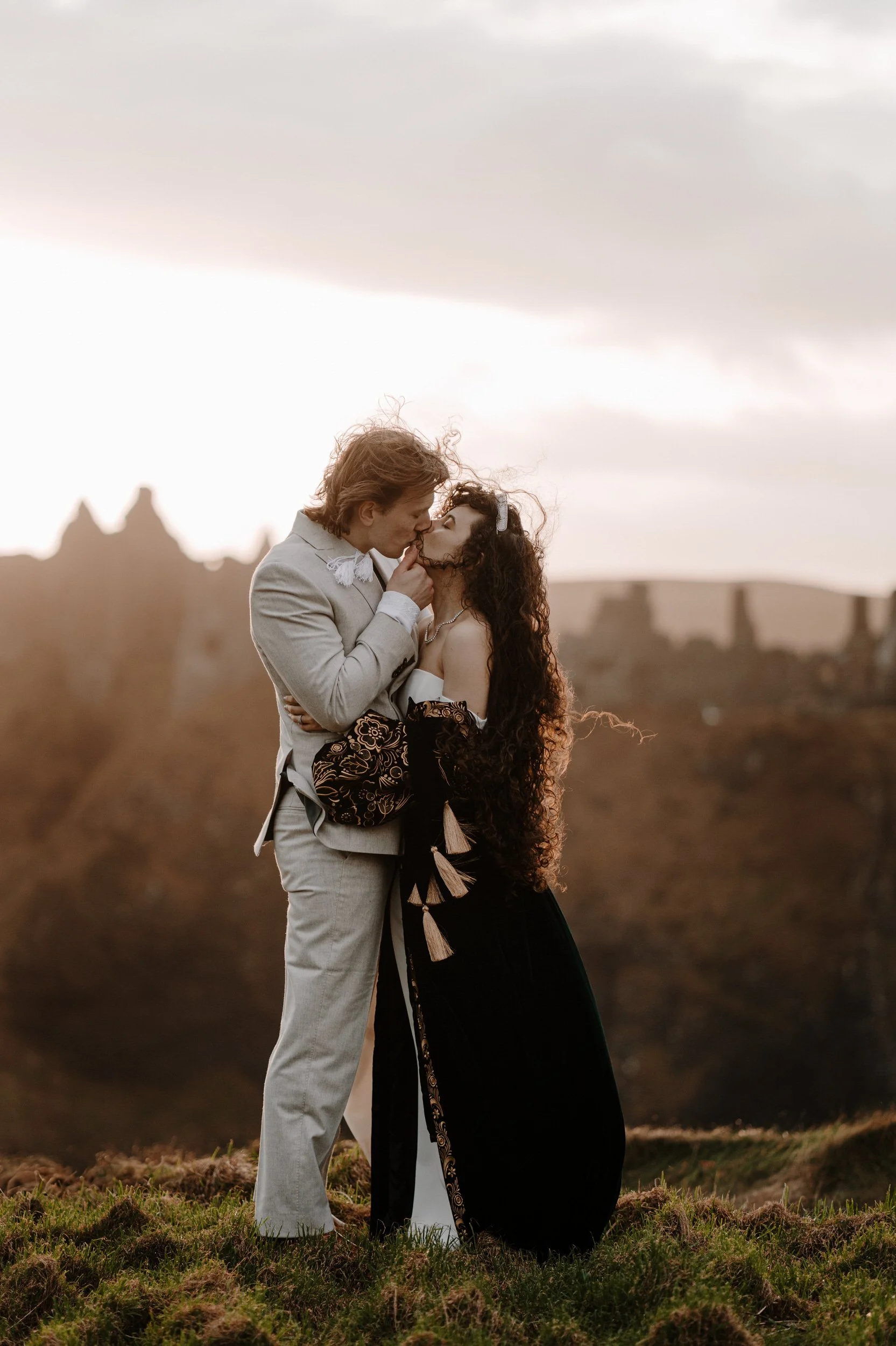
The Causeway Coast in winter is not a compromise. It is a specific, extraordinary thing that the other seasons cannot replicate. No tourists. A light quality that exists nowhere else at any other time of year. A quietness to the landscape that makes it feel owned rather than visited. a cosy pub with a fire going. Dunseverick castle at 3 pm, entirely empty, the sea a shade of pewter-grey that no summer photograph has ever captured.
This guide is for couples who already suspect they want this and just need someone to confirm it. It’s also for couples who assumed winter was off the table and are now reconsidering.
It is not for everyone. But for the right couple, dramatic, certain, not fussed about warmth, drawn to atmosphere over aesthetics, a winter elopement on the North Antrim coast is the finest version of this day.
In this post
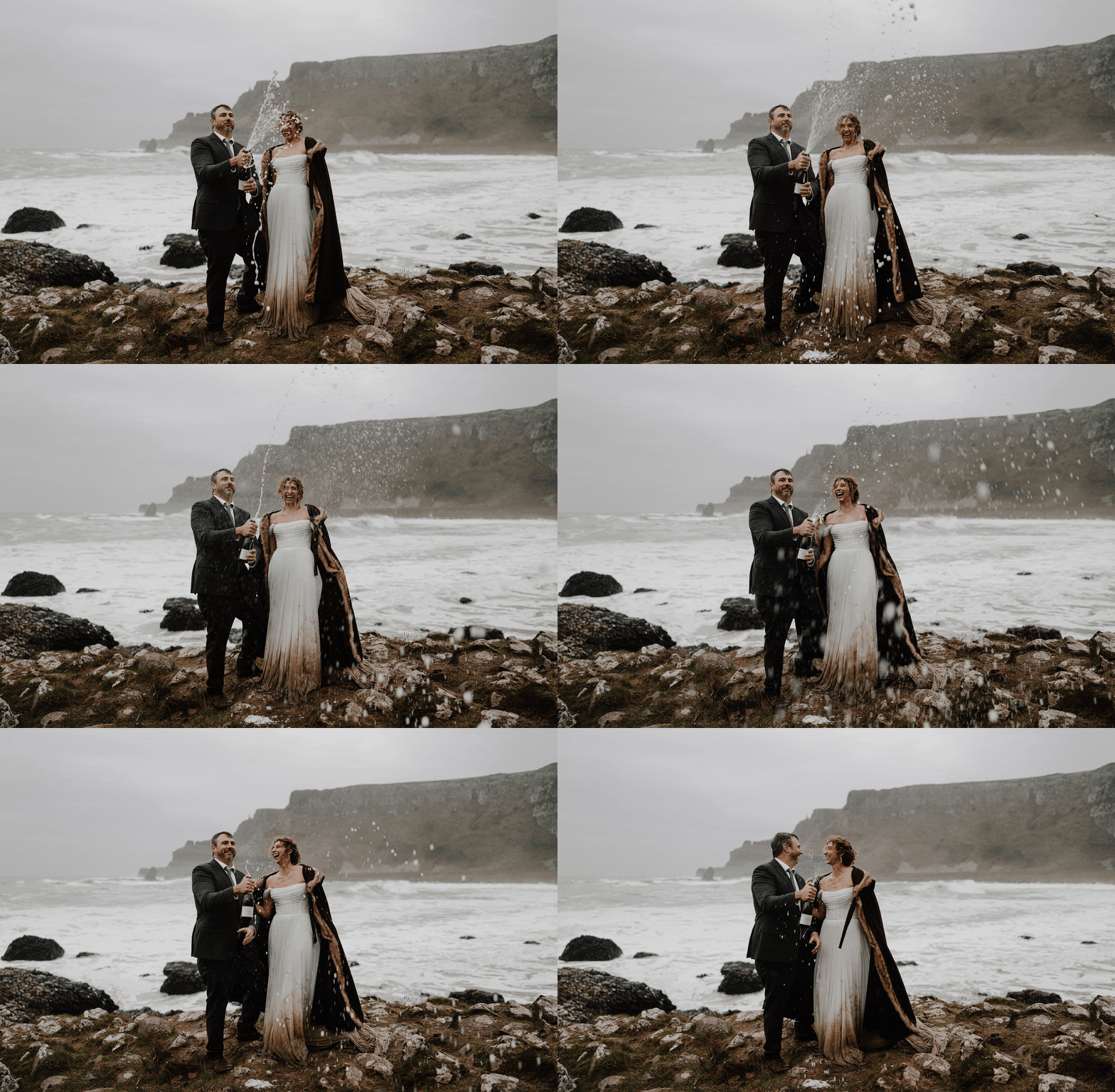
What Winter Actually Looks Like Here
Let’s start with the reality, because it matters. Northern Ireland is a maritime climate on the edge of the Atlantic. Winters are wet, windy, and grey, not bitterly cold in a New England or Scottish Highlands sense, but damp in a way that gets through layers regardless of temperature. The average January temperature hovers around 3–7°C (37–45°F). It rarely snows on the coast. What you get instead is low cloud, Atlantic squalls, frost on the grass some mornings, and skies that change constantly, the front moving in, the light breaking through, the mist lifting and resettling.
It sounds bleak when written down. In person, and in photographs, it is something else and utterly cinematic.
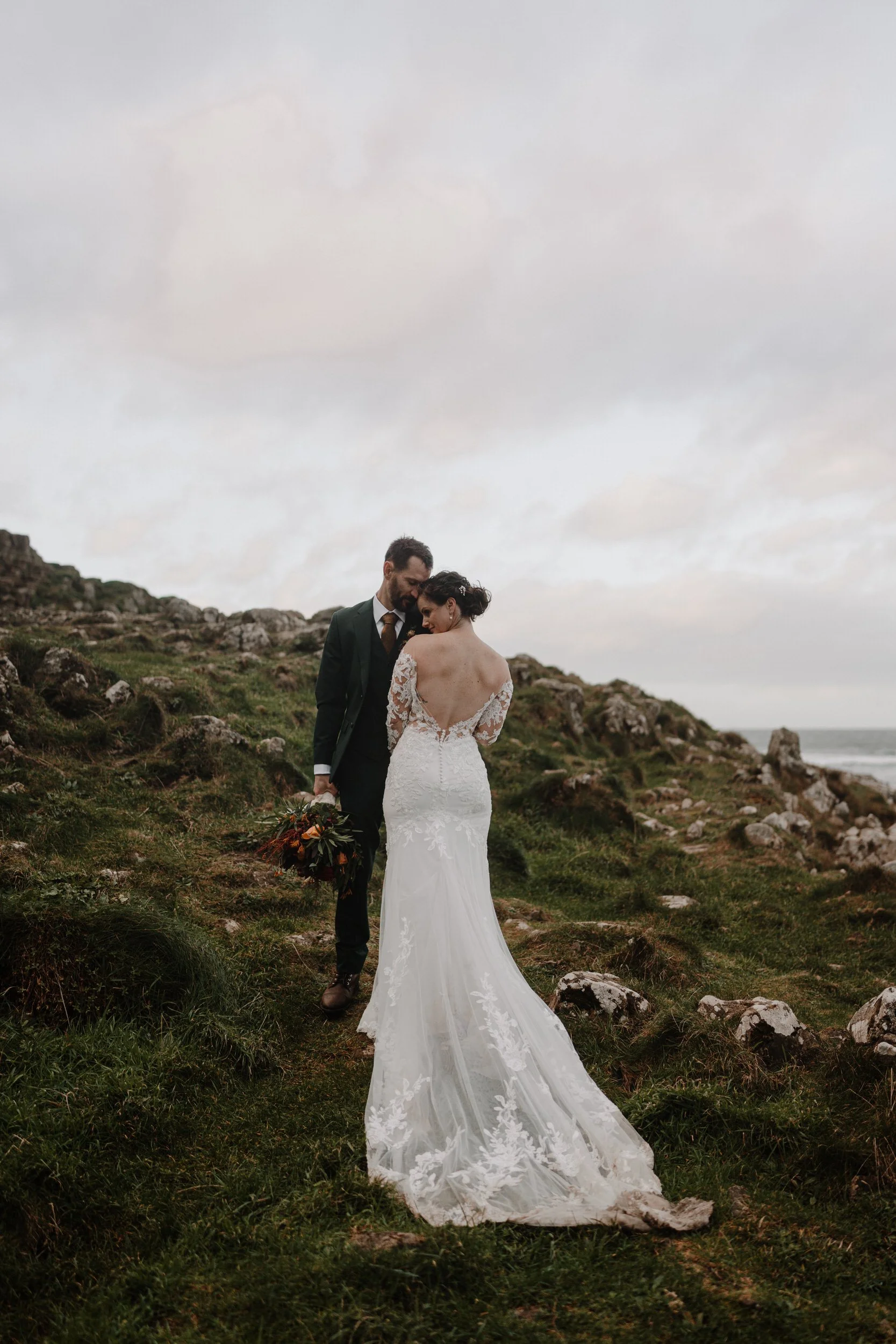
The greens saturate in rain. The ruins look ancient in the mist. There is a quality to the North Antrim coast in January that isn’t available on a sunny day in June: something wilder, more exposed, more honest. The landscape isn’t dressed for visitors. It’s just itself.
And you’ll have it almost entirely to yourselves.
The Light: Why Winter is a Photographer’s Dream
the thing that surprises everyone who hasn’t shot in winter at high latitude. In December and January, the sun never gets far above the horizon. At the winter solstice, the sun peaks at about 13 degrees of elevation, compared to 59 degrees in midsummer. What this means in practice: the low, directional, warm light that photographers chase for one or two hours at golden hour in summer is present from roughly 10am to sunset in December.
The whole day is golden hour.
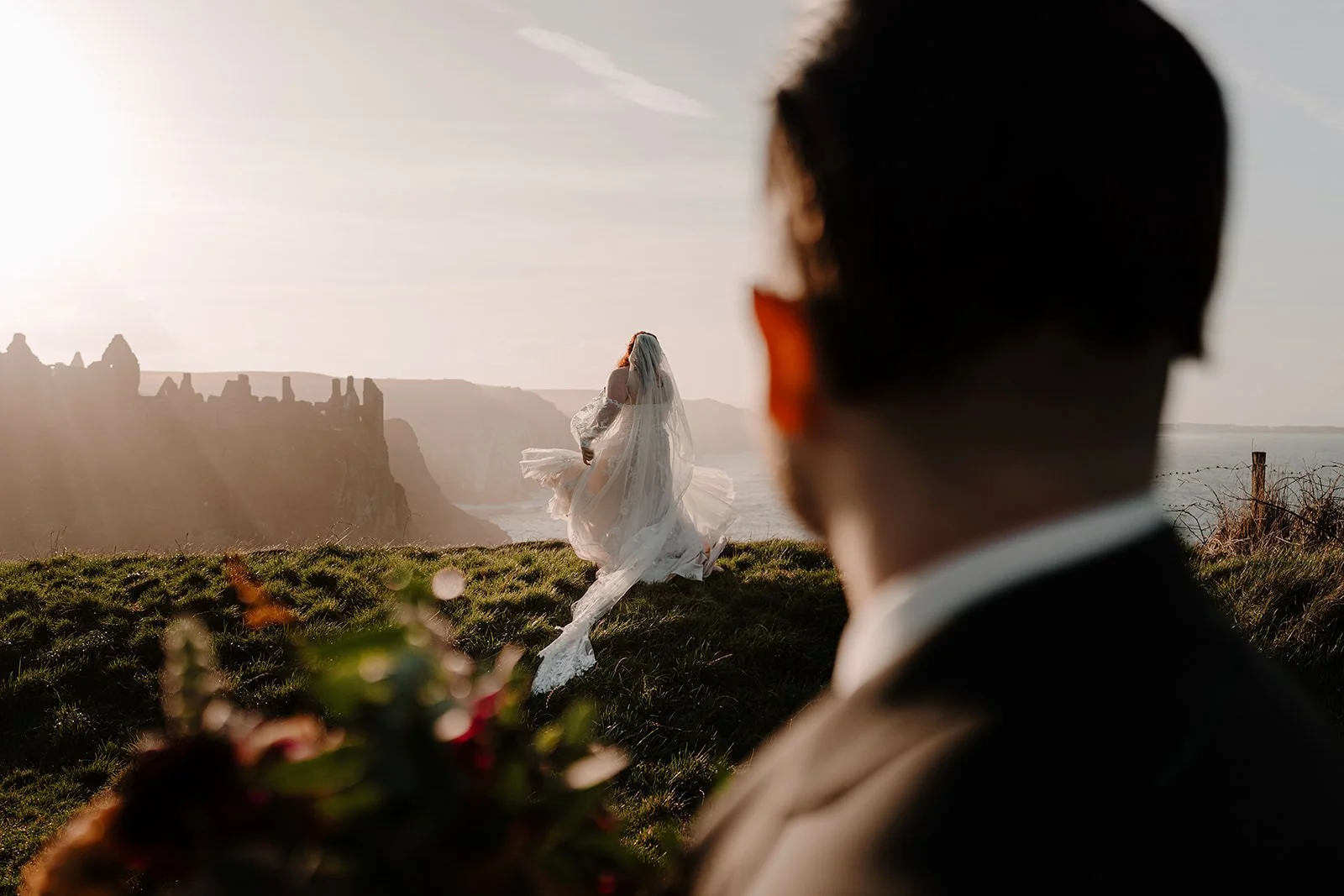
Not in the warm-amber tones of a July evening, but in a softer, cooler, more diffused version of that light, directional without being harsh, flattering without being saccharine. It hits faces from an angle that summer midday light never achieves. It rakes across the cliff faces at Kinbane and lights the basalt columns from the side. On overcast days, the cloud acts as an enormous diffuser and the light becomes even, beautiful, and infinitely forgiving.
I shoot elopements in summer and I chase golden hour like everyone else. But the photographs I return to most, the ones that surprised me, often come from winter sessions. There’s a depth of tone, a richness to the shadows, a colour in the sky that summer simply doesn’t produce.
Month by Month: What to Expect
November
November is the quietest month on the Causeway Coast. The summer visitors are completely gone by the first week. Accommodation prices drop. Sunset sits between 4:15pm (early November) and 3:55pm (by the 30th). The trees on the approach roads are in their last autumn colours, then bare, then skeletal, each version beautiful in its own way.
The weather in November can go either way. You might get a bright, cold, still day with extraordinary low light. You might get two days of horizontal Atlantic rain. Usually you get both in the same afternoon. November requires flexibility: a willingness to step into whatever the day gives you and work with it rather than against it.
The coastal grass is a deep, saturated green. The ruins look their most weathered. And the whole North Coast, which was genuinely crowded in July, feels like it belongs to you alone.
Best for: Couples who want absolute privacy, autumn-to-winter transitional aesthetics, and don’t mind the unpredictability.
December
December is the committed winter. Sunset between 3:50pm and 4:05pm. The solstice on the 21st is the shortest day of the year: approximately 7 hours and 20 minutes of daylight, with sunrise around 8:45am and sunset around 3:52pm.
That is not a large window. But it is a very beautiful one.
A December ceremony needs to be timed precisely. Aim to be at your ceremony location by 1pm at the latest; earlier if you want portraits before the vows as well as after. The light begins its final decline around 2:30pm, turns warm and directional by 3pm, and by 3:45 you’re in blue hour. That transitional period, the 45 minutes either side of a December sunset, is some of the most extraordinary light I’ve ever worked in. The cliffs go from green to gold to copper to dark in real time. The sea changes colour faster than you can capture it.
December also means the North Coast is completely, utterly empty. Dunluce Castle field with no other visitors. Kinbane on a December afternoon is as close to solitary as you can get on a public site in the UK.
Christmas week itself is the one exception to the quiet rule: some visitors return to the coast for the holiday period and accommodation fills up. The two weeks either side of Christmas are quieter. The first week of December and the last week of January are the emptiest times of the year.
Best for: Couples who want the darkest, most dramatic, most atmospheric version of this. Short window, high stakes, extraordinary reward. And for a very specific subset of couples: the ones who want their elopement to feel like a secret, a thing that belonged only to them.
January
January is the forgotten month for elopements, and I think it’s underrated.
Sunset is moving back from its December nadir. The 1st of January sits around 4:05pm. By the 31st, you’re approaching 5pm. The extra 50 minutes of evening light makes practical planning significantly more comfortable. January is often drier than December; the worst Atlantic weather tends to fall in November and December, and by January you get stretches of cold, clear days that are genuinely beautiful.
Post-Christmas, the coast is emptied out again. Nobody is there. Accommodation is at its cheapest of the year. The Bushmills Inn is open and quiet. You’ll walk into a restaurant on a Tuesday evening and have the place to yourselves.
If you’re drawn to a winter elopement but nervous about the 4pm December deadline, January is the more forgiving version. You still get the empty landscape, the winter light quality, the absence of tourists, with a slightly more comfortable shooting window.
Best for: The practical winter elopement. All the atmosphere of December with a bit more breathing room.
February
By February the light is returning noticeably, with sunset around 5:30pm by the end of the month, which starts to feel like a proper afternoon. Early February still has the winter emptiness. Late February begins to feel like the beginning of something else.
February is the sweet spot for couples who want winter aesthetics without committing to the hardest version. You get the low, soft light without the brutal 4pm deadline. Accommodation and flight prices are still at their lowest. Valentines’ week sees a small uptick in bookings; the weeks immediately before and after are quieter.
One thing specific to February: the Atlantic coast in late winter can have days of extraordinary clarity, particularly after a storm has cleared. The sea runs a deep, almost Mediterranean blue on cold, still days. It doesn’t look Irish. It looks Icelandic. And then the following afternoon it’s grey and wet and relentlessly itself again.
Best for: The perfect entry point to winter eloping. Atmospheric but manageable. The best bang-for-buck of the year for light, price, and privacy combined.
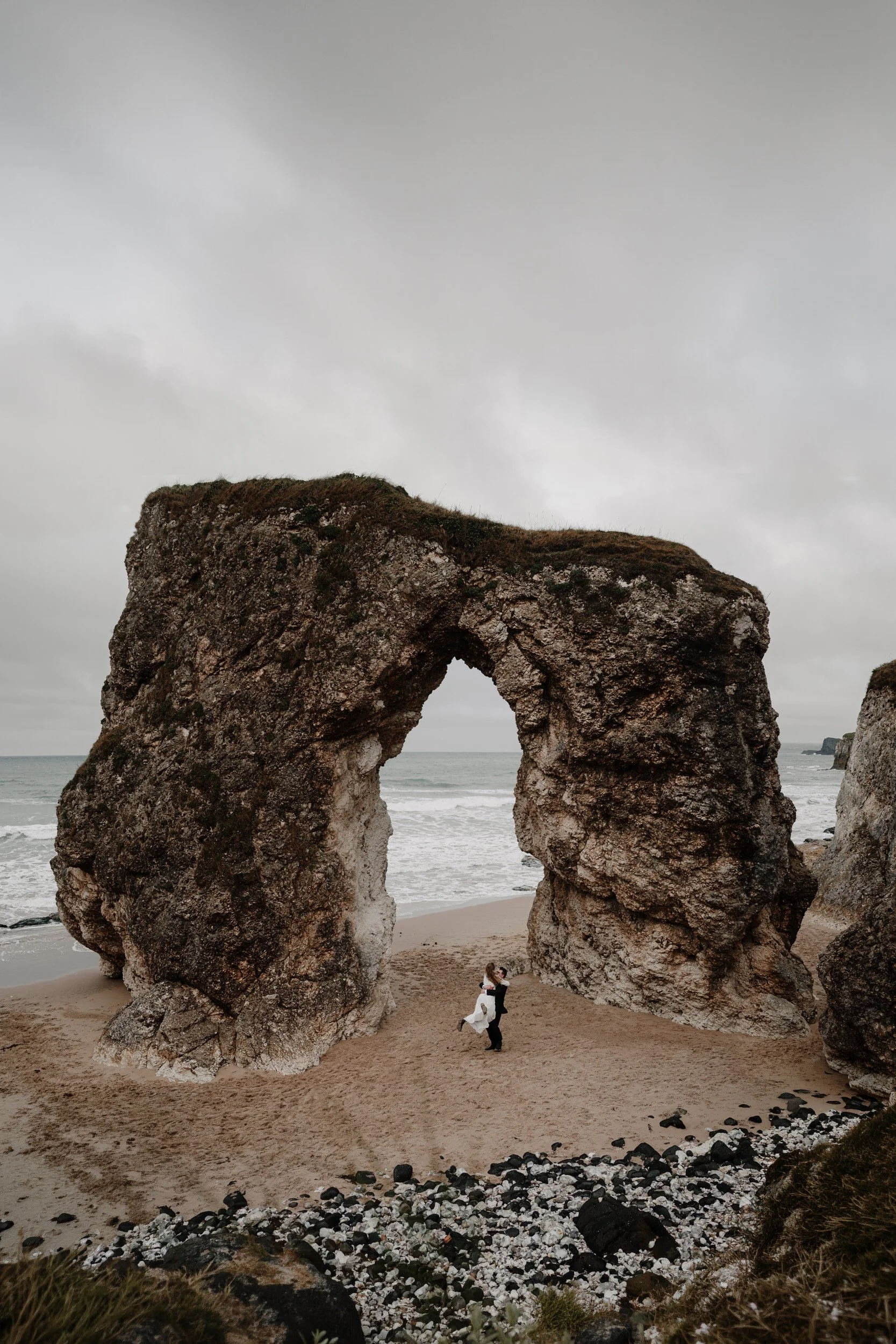
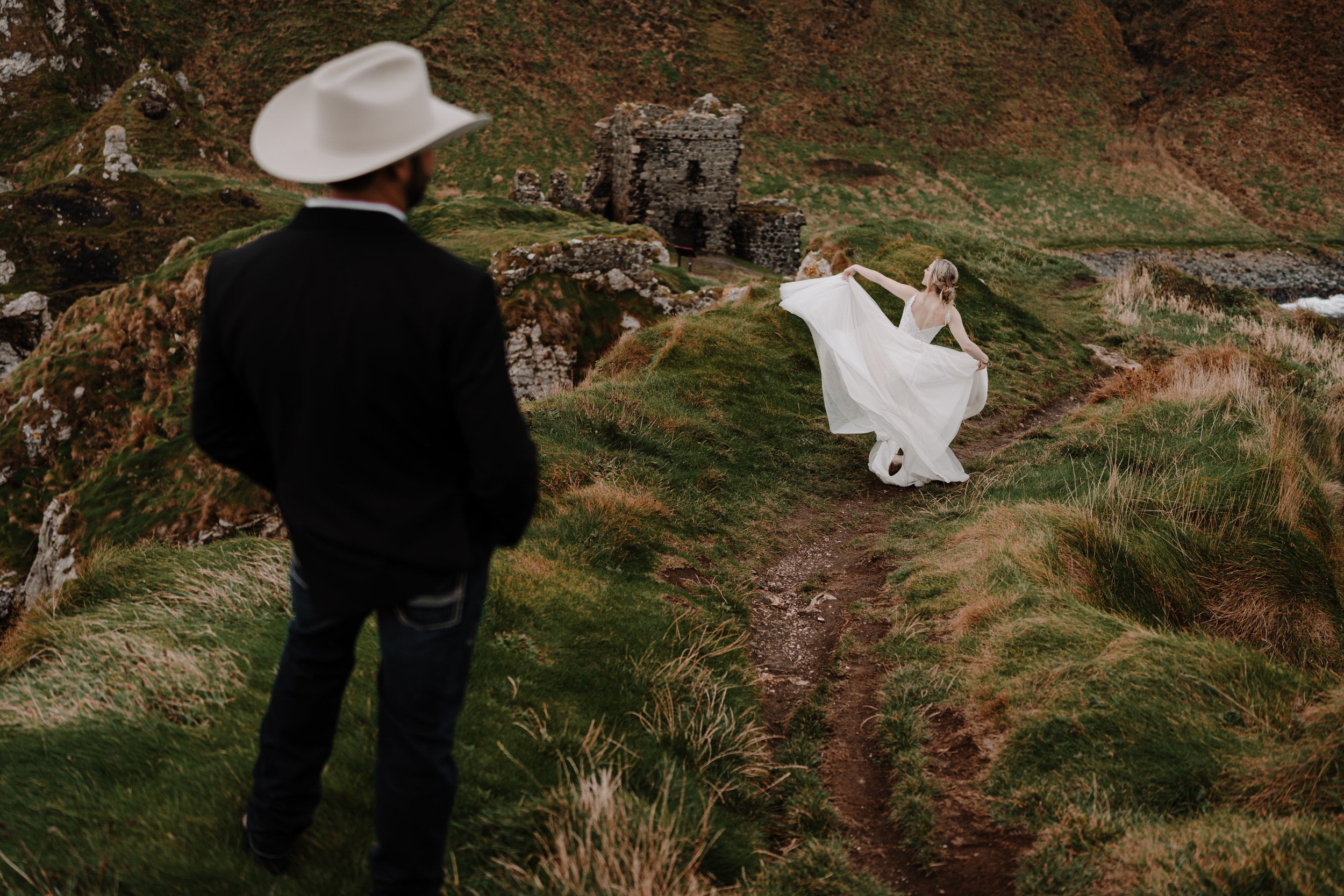
Practical Timing: Working Within the Winter Window, a few examples of how timings could work
For November and February, when sunset sits between 4:15pm and 5:30pm, a standard elopement timing works well:
10–11am: Get ready at your cottage or accommodation
12pm: Travel to first location
1–2pm: First location
2 pm: Ceremony at the latest
3–4pm: Golden hour portraits
4:30–5pm: Blue hour. Keep shooting.
5pm: Done, warm, celebratory pint by the fire
For December and early January, when sunset arrives before 4:15pm, everything shifts earlier:
8–9am: Get ready. The getting-ready session is part of the day, so start early.
10am: Travel and settle into the first location as the light comes in
10am–12pm: Pre-ceremony portraits while the winter light is at its best
12:30 pm: Travel to ceremony location
1pm: Ceremony.
2:15–3:45pm: Portrait session as the light drops
3:45–4:15pm: Blue hour. Do not pack up early. The ten minutes after sunset in December on the Causeway Coast are not to be wasted.
4:30pm: The day is done and the dark is in. Find the fire.
The elopement timeline guide goes into more depth on how to build a day that doesn’t feel rushed. Winter elopements especially need this thinking done in advance, because once the light goes, it goes.
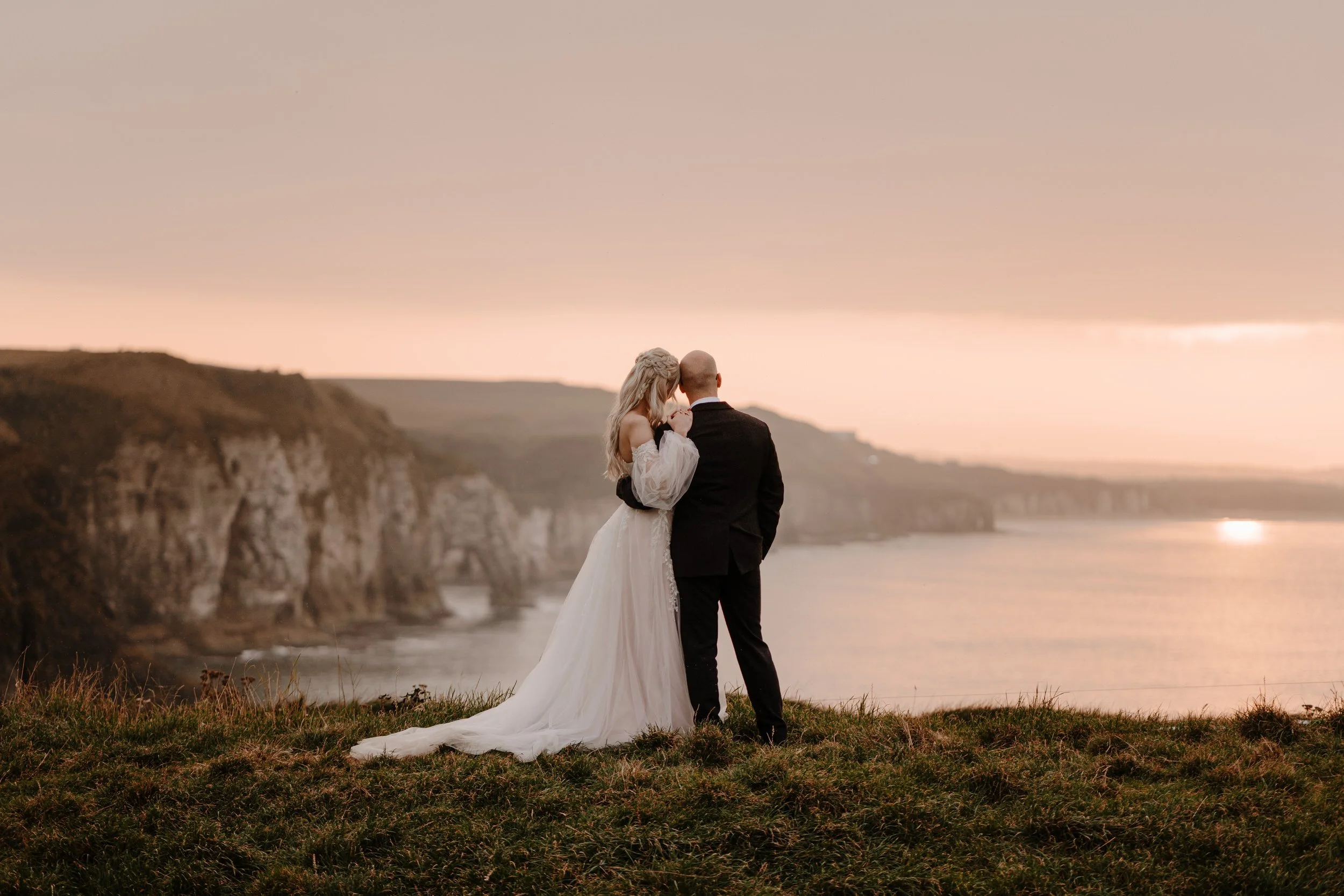
Where to Go in Winter: Location Notes
Not all locations are equal in winter. Here’s how the main ones change.
Dunluce Castle field: Works beautifully. The field is exposed, the wind is real and the cold is real, but the visual is extraordinary. The ruins in winter light, with the Atlantic running and no tourists anywhere, is as good as it gets. In December, aim for a 1 pm ceremony and let the light fall across the ruins as you say your words.
Kinbane Castle: The 140 steps are more challenging in wet, cold conditions; they can be slippery. Take your time, hold onto each other, wear footwear with grip. At the bottom, the winter headland is extraordinary: the sea rougher, the light more dramatic, the ruined tower more itself than in any other season. The ascent back up is harder after an hour in the cold. Factor in more time than you think.
Dunseverick Castle: Winter mornings are when Dunseverick is at its most itself. The ruins sit right at the cliff edge, and in winter the sea below is loud and the sky is wide and the whole headland feels like yours alone. The light from the northeast hits the stonework at an angle that makes the ruins look ancient in a way that photographs in summer never quite capture. you will usually have it completely to yourselves.
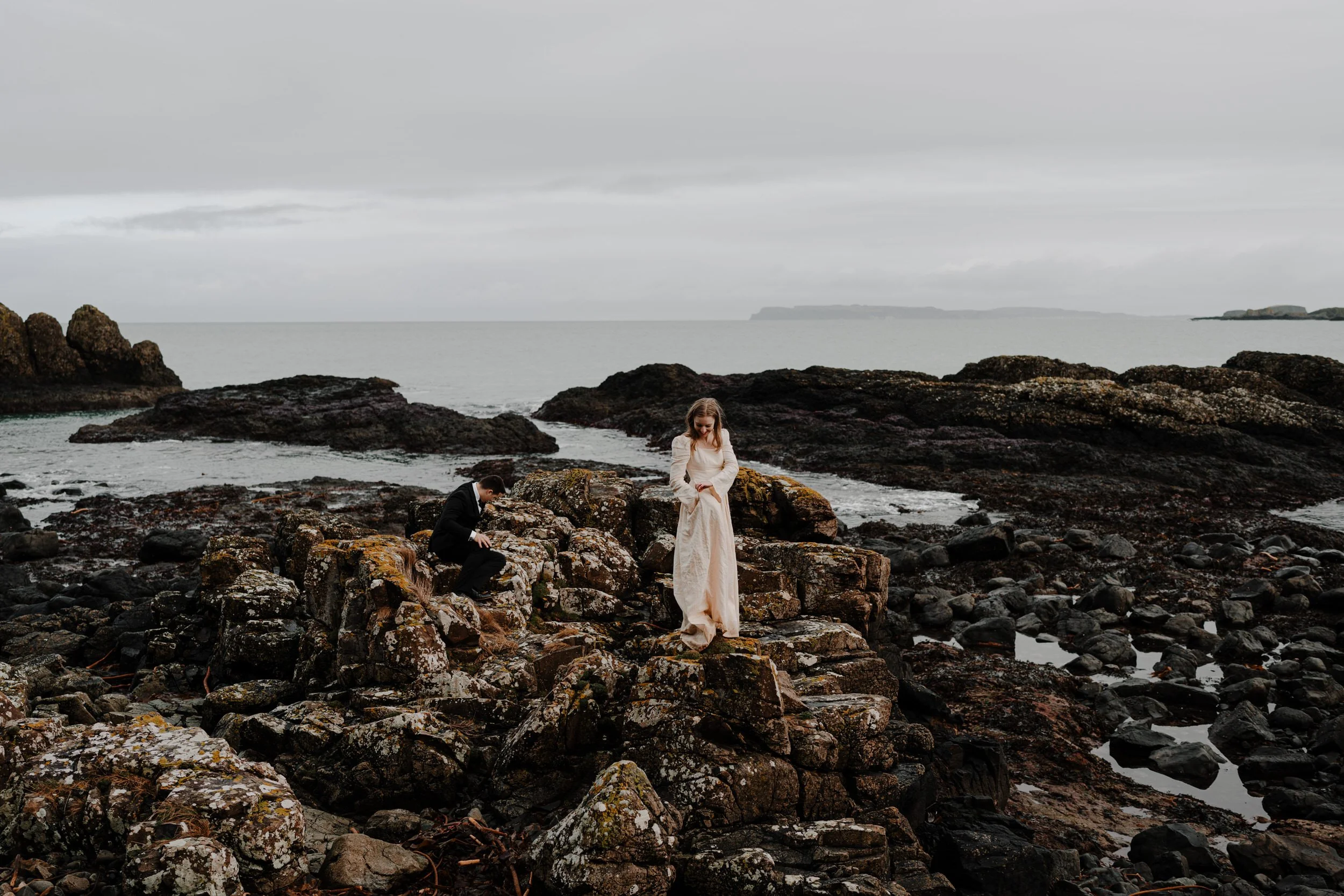
Ballintoy: In winter, Ballintoy Harbour and the surrounding coastline are extraordinary. The harbour is quiet, no summer crowds, no coach parties, and the combination of the white limestone, the dark water, and the low winter light creates something genuinely striking.
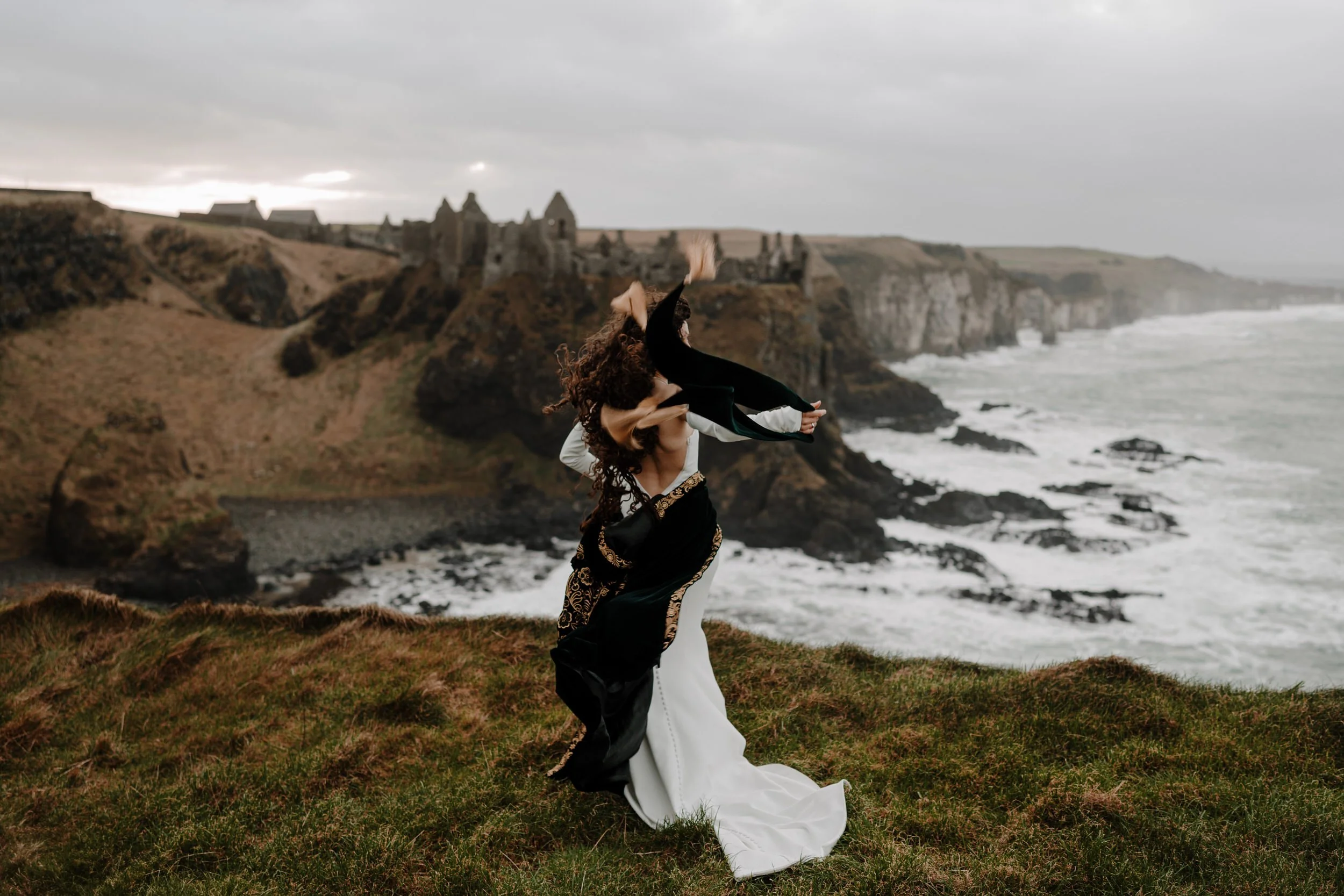
What to Wear
The Causeway Coast in winter does not care about your aesthetic preferences. It will find every gap in your layers. Here’s how to dress for it without looking like you gave up.
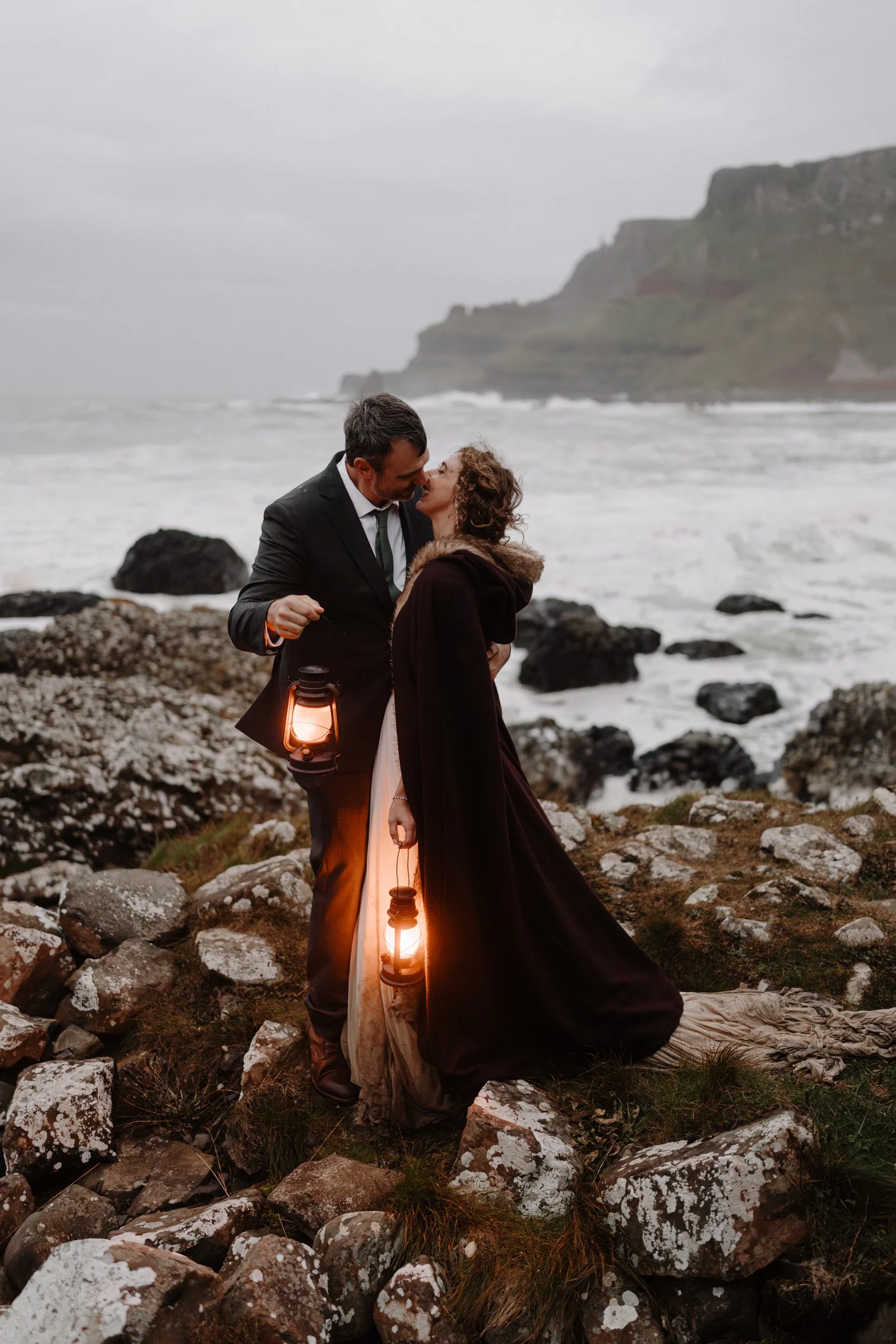
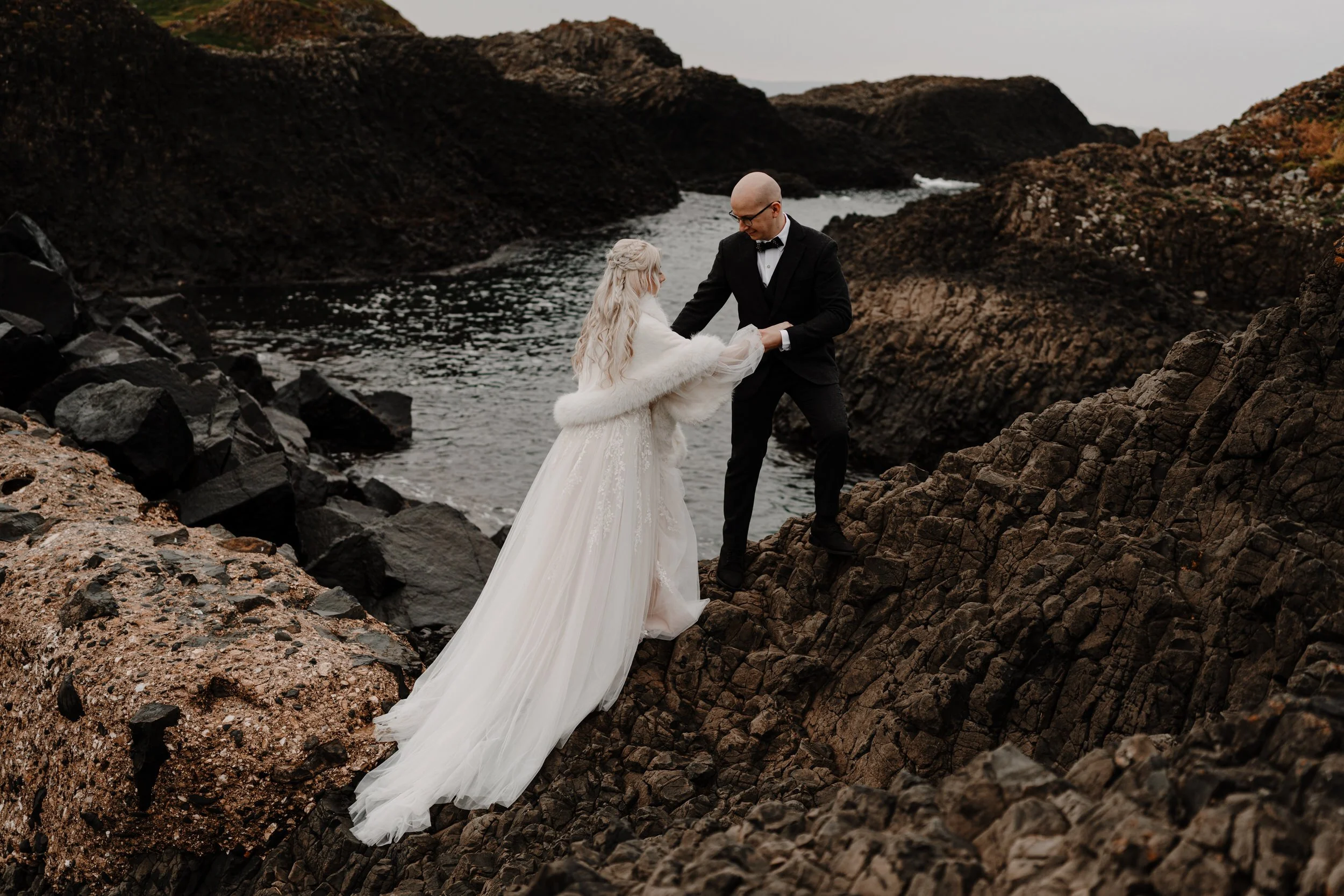
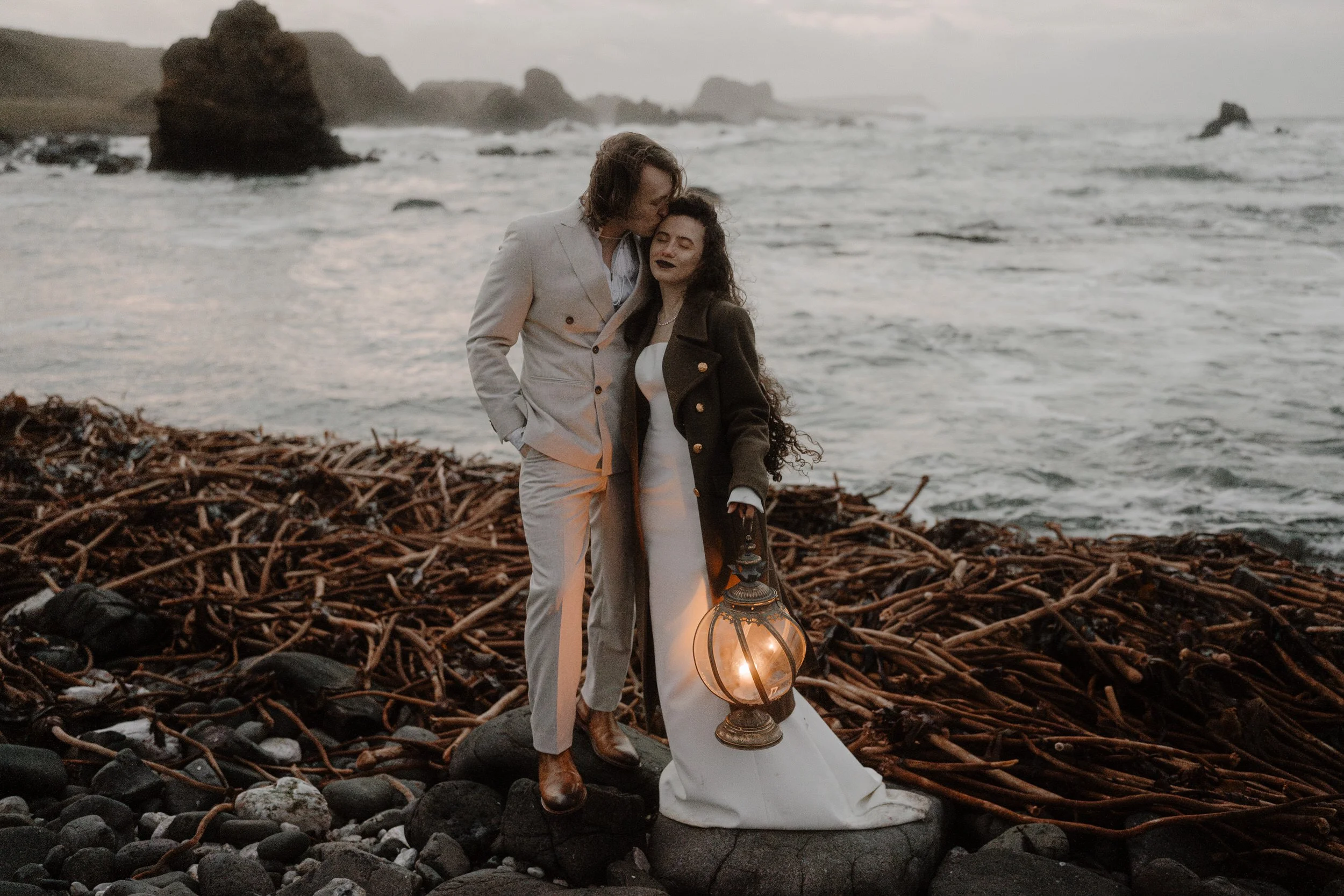
The coat is the thing. Find a coat that photographs well, that you love wearing, and that is genuinely warm and windproof. A structured wool overcoat in a deep colour. A tailored leather jacket over a thick knit. A long shearling, a cloak, These all look extraordinary and provide real warmth. What doesn’t work: thin fashion coats that look great standing still in a city. The Atlantic wind is not a city wind.
Under the coat: Layers. A thermal base layer that sits under your dress or suit is invisible in photographs and transformative in comfort. Thermal tights under a dress. A fine-knit layer under a jacket. You can always take a layer off for a specific shot; you can’t create warmth that isn’t there.
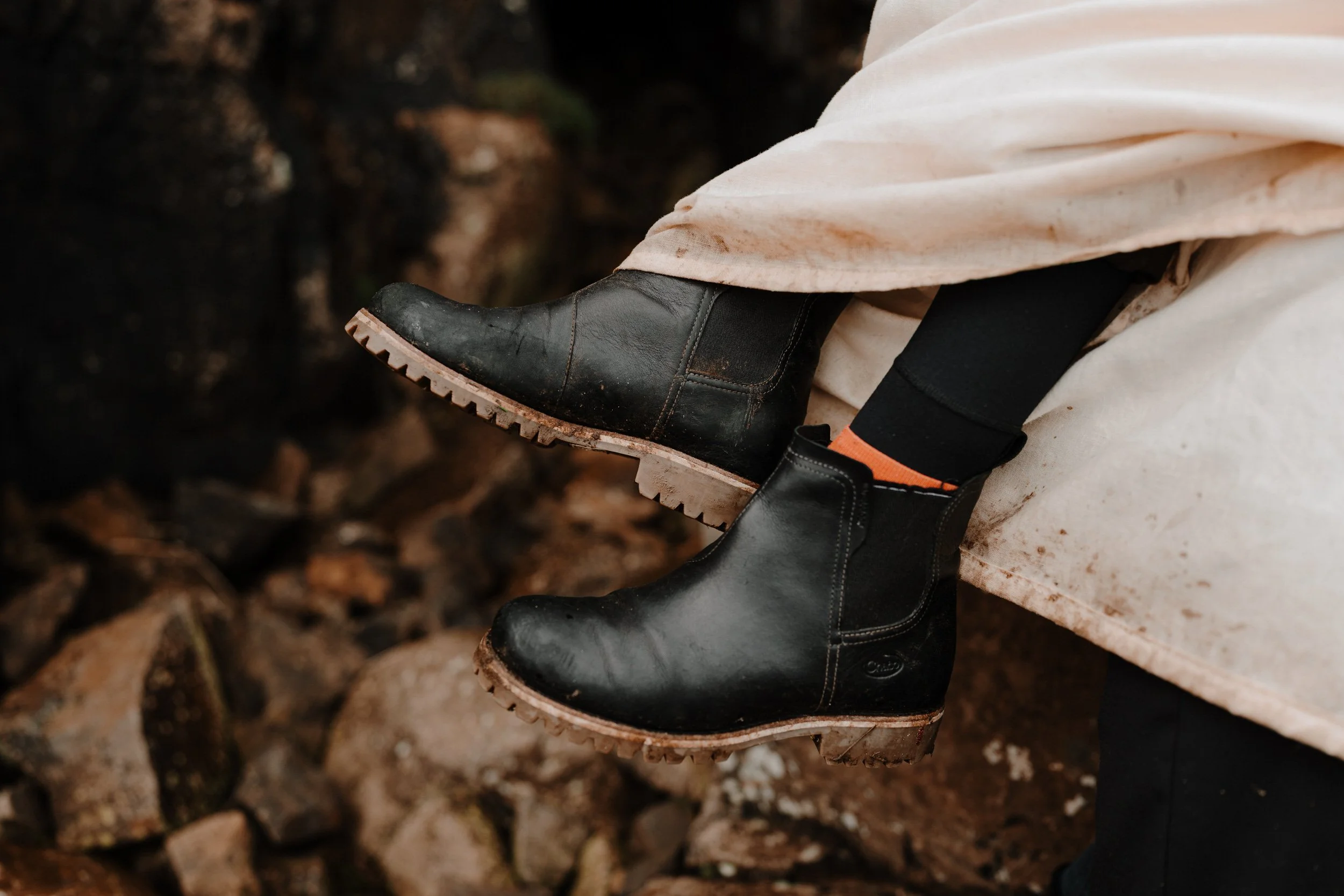
Footwear: Ankle boots, Chelsea boots, lace-up boots, avoid heels and fancy shoes at all costs. The grass will be wet. The stone steps will be wet. What won’t work: stilettos, open-toe shoes, thin-soled dress shoes on frozen ground. Think grip first, then style.
Accessories as features: A well-chosen scarf or wrap photographs beautifully in wind. Leather gloves look good and keep your hands warm. These aren’t compromises, they’re additions.
For grooms / non-dress partners: A well-fitted overcoat over a suit is one of the most timeless looks there is. Irish tweed is not an affectation in this context; it’s practical, it’s beautiful, and it reads as intentional rather than costumed. Heavy wool trousers over thermals. Proper leather boots rather than dress shoes.
For all elopements
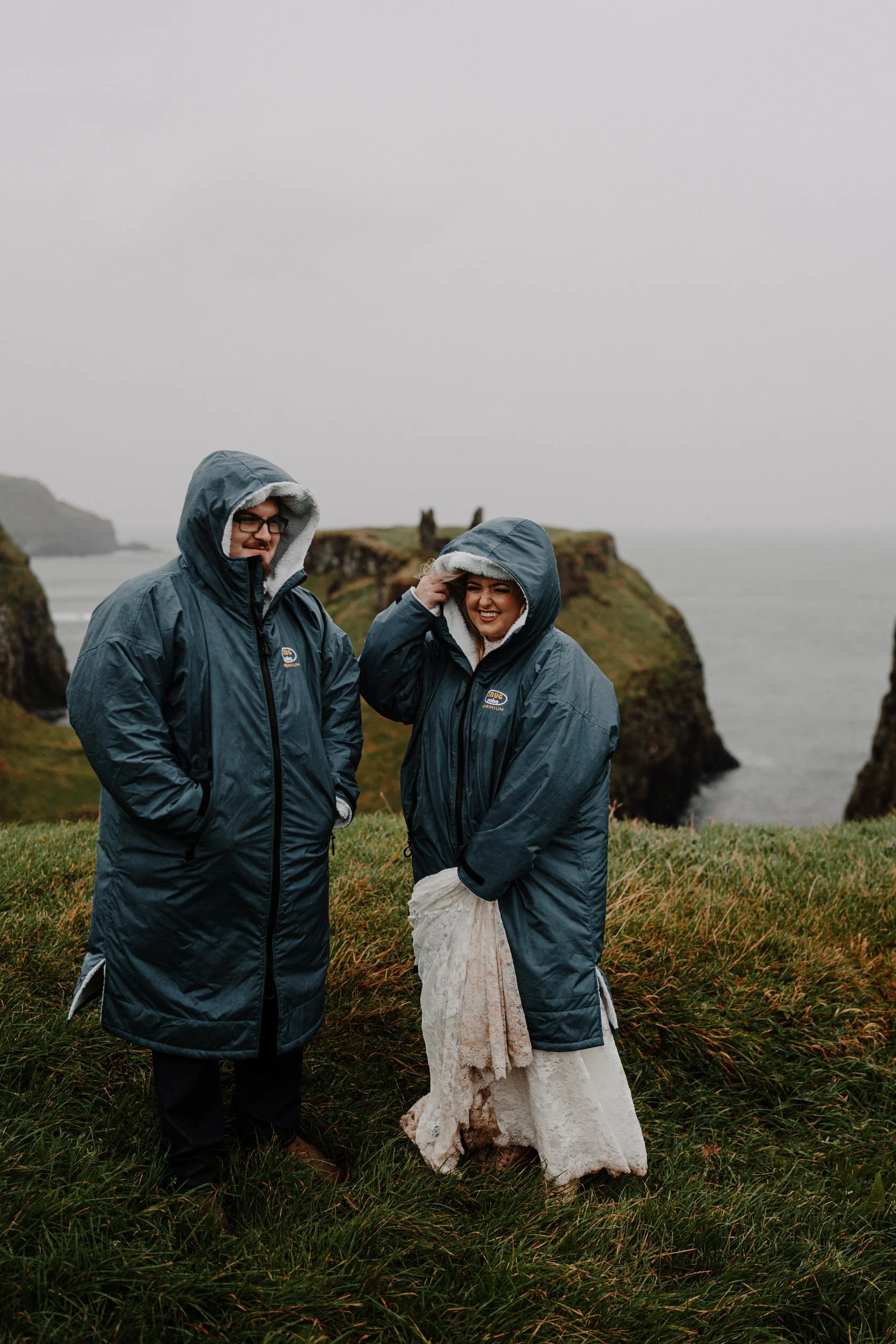
I carry an awesome set of dry robes to keep you dry and warm during our adventure
The Winter Practical Advantage
Beyond aesthetics, winter has material benefits that shouldn’t be overlooked.
Flights are significantly cheaper. November, January, and February are the lowest-demand months for transatlantic travel to Belfast. A return flight from New York that costs $700 in September might be $430 in January. For couples travelling from the US or Europe, this difference can offset a meaningful portion of the photography or accommodation budget.
Accommodation is a fraction of the summer price. A cottage in Portballintrae that costs £200 a night in August might be £80 in January. The Bushmills Inn has genuinely good winter rates. You can afford to stay somewhere better for longer.
The vendors you want are available. Humanist celebrants, florists, makeup artists , the ones who are booked solid from May through October have availability in January. You’re not competing with the summer elopement rush.
The Questions Winter Couples Ask
Will we regret not having good light?
You will have excellent light. Winter light in Northern Ireland is not bad light; it’s different light, and in many ways, better light for portraiture. What you will not have is a warm, amber, 9 pm sunset. You’ll have something darker and more compelling instead.
What if it rains the whole day?
It won’t rain the whole day. Atlantic weather at any time of year moves quickly , what’s grey and wet at 11am can be clear by 2pm and dramatic by 3pm. Rain on the Causeway Coast in winter is not a disaster. Wet stone, mist over the Atlantic, the light going silver through the rain , this is not a ruined backdrop. It’s an extraordinary one. Bring an umbrella for in-between moments, wear layers that handle getting damp, and trust that the photographs will be extraordinary.
Does it snow?
Occasionally, and briefly. The coastal areas of Northern Ireland rarely see significant snow because the Atlantic keeps temperatures mild. The Mourne Mountains inland can have snow cover in January and February , spectacular if you want to make a day of it. On the Causeway Coast itself, what you’re more likely to get is frost on the ground in the morning that’s cleared by midday, which gives you a beautiful hour of frosted grass and low mist that’s genuinely magical.
Won’t it be miserable?
No. It will be cold. There’s a difference. Cold is cured by good layers, warming up in the car between locations, and ending the day at a fire with something warm to drink. Miserable is the feeling of having chosen the wrong thing. Couples who choose a winter elopement on the Causeway Coast almost universally report that the day was better than they imagined , partly because the expectations were calibrated differently, partly because there’s something uniquely intimate about facing a cold, dramatic landscape together and finding it beautiful rather than intimidating.
The couples who do this are a specific kind. They’re not settling for winter because summer was full. They chose this. And you can feel that in the photographs.
The Year-Round Picture
I’ve written guides for eloping in the summer and eloping in the fall, and this guide completes the picture. Every season on the Causeway Coast is a different thing.
Summer is long light, warm evenings, the landscape at full saturation, couples wandering barefoot. Autumn is golden and moody, the best balance of light and quiet. Winter is stripped back, raw, and completely itself. Spring, which I’ll write about separately, is all potential and new colour and the cliffs bursting back into green.
None of these is the right answer for everyone. The right answer is the one that sounds like you when I describe it.
If the winter version , the short day, the empty coast, the fire at the end of it , sounds like you: let’s talk.
Hi I’m Christin
An elopement Photographer, based in Northern Ireland.
For the last 11 years I’ve been documenting and helping couples plan their dream elopements in Ireland